
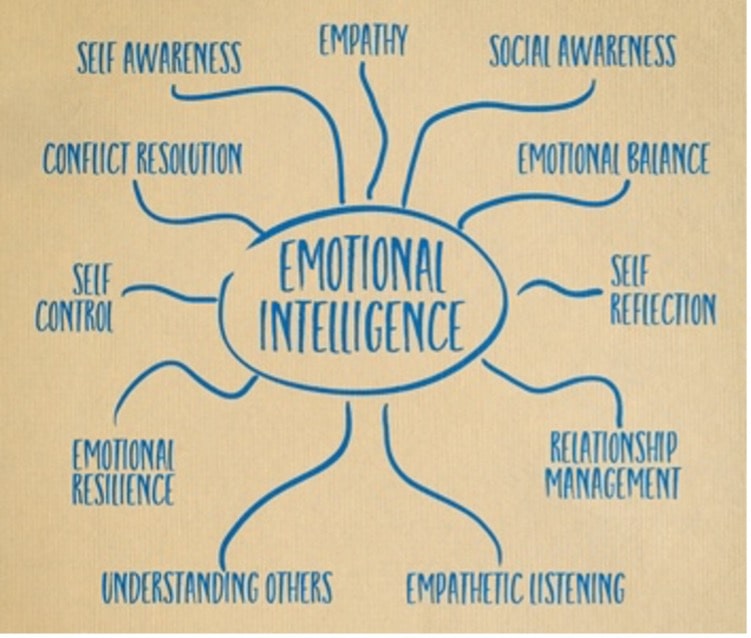
Emotional intelligence, also known as emotional quotient (EQ), is critical for self-leadership, interpersonal relationships, effective performance, and personal or professional advancement.
Tapping into your EQ intensifies your awareness and helps you pick up on subtle cues others may be sending. With this insight, you can then adapt accordingly and demonstrate your communication acumen through listening with positive intention.
Furthermore, expressing your appreciation, even if you disagree with another person’s perspective, is a great way to boost feel-good hormones like dopamine, endorphin, and serotonin, promoting happiness and well-being.
Balance isn’t a permanent state; it requires continual awareness and tweaking.
Self-regulation is a skill. With practice, you can learn ways to calm your system, temper your automatic instinctual reactions, and minimize potential response “snafus” when you’re activated by unexpected interruptions or feel out of sorts.
Additionally, shifting your mindset can help you stay grounded and bounce back when things go awry. For example, regularly pausing to connect with yourself can help you manage your emotional waves. Also, learning to recite insightful phrases like “Why Am I Talking, aka WAIT,” or “I’d rather be happy than right” can help you improve the quality of your experience rather than perpetuate a negative one.
Your needs, values, and expectations play a role consciously and unconsciously.
It’s essential to recognize the difference between what you need, i.e., what you require to sustain your well-being, what you value, i.e., your guiding principles regardless of who else is involved, and your expectations, i.e., strong beliefs that shape your reality regarding what you prefer and want from others, such as acting a specific way. This is because all of these aspects set the tone for how you show up.
In Norton Juster’s story, The Phantom Tollbooth, the main character Milo learns: “Expectations is [sic] the place you must always go to before you get to where you’re going.” For example, it’s easy to blame others or an organization when you are unhappy or frustrated. However, focusing on what’s within your control, such as sharpening your emotional intelligence, can help you embrace a fresh perspective and unlock your potential.
Practice and experimentation are necessary for growth.
You can boost your EQ using Multi-Health Systems’ EQ-i 2.0® or EQ 360® assessment. The analysis indicates how you perceive you are using or not using the 15 core emotional intelligence skills. And provides you tips and techniques to improve and balance out your skills with others to enhance your well-being, interpersonal relationships, communication, and performance. If you choose the 360 version, your scores will be shown alongside those of the people you’ve asked to participate in your feedback, including personal and professional contacts.
Here’s a brief overview of the composites with their corresponding competencies:
#1 Self-Perception
Self-Perception focuses on your inner strength and confidence, exploring how different emotions shape your thoughts and actions. The composite includes: (1) Self-Regard, which looks at how you respect and accept yourself holistically, (2) Self-Actualization, the pursuit of continuous improvement and engaging in purposeful activities, and (3) Emotional Self-Awareness, which assesses how you discern between your emotions and those of others and their impacts.
#2 Self-Expression
Self-Expression covers how you interpret your perspectives and express them to others regarding what you think or feel. This composite includes: (1) Emotional Expression, i.e., how you share or don’t share your emotions with others and the implications of that, (2) Assertiveness, how you speak up and communicate thoughts, feelings, and beliefs in a constructive and socially acceptable manner, and (3) Independence, which correlates with your ability to self-direct yourself in terms of planning, deciding, and completing your to-dos.
#3 Interpersonal
Interpersonal is related to how you interact with others, e.g., developing and sustaining mutually satisfying relationships. This category includes: (1) Interpersonal Relationships, which is the skill of fostering trust and connection with others, (2) Empathy, i.e., your ability to exhibit that you understand and appreciate other people’s sentiments and views compassionately, and (3) Social Responsibility, which entails acting responsibly and contributing to the greater good.
#4 Decision Making
Decision Making looks at how you use emotional information and its impact on your conclusions. This grouping includes: (1) Problem Solving, i.e., your skills in pinpointing solutions despite strong sentiments being involved, (2) Reality Testing, your ability to see things objectively and know when beliefs or biases interfere, and (3) Impulse Control, the knack to resist an urge or postpone a desire.
#5 Stress Management
Stress Management is how you handle yourself in uncomfortable or tense situations. This composite includes: (1) Flexibility, your ability to adapt and remain responsive when dealing with unpredictable circumstances, (2) Stress Tolerance, your belief around your capabilities regarding dealing with distress and difficult situations, and (3) Optimism, an indicator of your outlook and remaining resilient and hopeful in the face of challenges and disappointment.
Aim for betterment, not perfection.
As human beings, we are complex—emotionally, physically, and scientifically. Knowing and accepting all parts of who you are—your persona, core motivation, values, preferences, instinctual tendencies, traits, fears, strengths, weaknesses, and behaviors—is about being honest and taking accountability for your thoughts, actions, and feelings. As you focus on making positive improvements and progress toward your standard of excellence, celebrate the wins, learn from the losses, and give yourself some grace and self-compassion, treating yourself as you would a good friend.
Activate your best with those around you.
Self-leadership is about getting to know yourself better and applying that knowledge to how you interact with others. As a lifelong student, certified professional coach, and consultant, activating the best in others through self-leadership, interpersonal relations, and team dynamics are passions of mine. My approach is personalized and customized, tapping into various assessments, disciplines, modalities, and techniques. Contact me to learn more.